Figma to WordPress: Building Native Themes in Minutes with transjt.ai
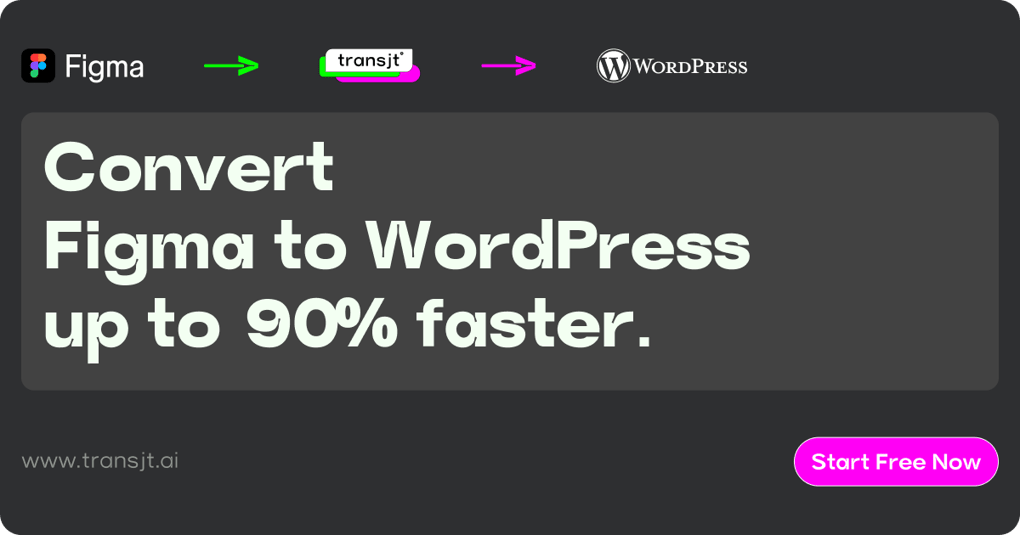
The WordPress ecosystem powers nearly half the internet, but the workflow for building custom sites hasn't fundamentally changed in years. If you are an agency or a freelance developer, you generally have two choices when turning a Figma design into a live WordPress site:
- The Slow Route: Spend weeks manually coding HTML, CSS, JavaScript, and PHP to build a custom theme from scratch.
- The Bloated Route: Use heavy page builders (like Elementor or Divi) to visually recreate the design, which often sacrifices site speed, code cleanliness, and SEO performance.
But what if you could bypass both? With the expansion of transjt.ai into the WordPress ecosystem, the bridge between a static Figma canvas and a dynamic WordPress CMS is finally being automated.
Here is an inside look at how the Figma-to-transjt-to-WordPress workflow will let you build fast, custom WordPress sites without writing a single line of PHP.
Why Automated Native Code Matters for WordPress
There are already tools that export Figma to WordPress, but most of them just generate a massive, messy block of code, or they lock you into a proprietary page-builder plugin.
The magic of transjt.ai is that it generates clean, fully responsive code alongside native architecture. Just as it creates native HubL for HubSpot, transjt is designed to read your visual layouts and translate them into fluid, semantic WordPress structures—think native Gutenberg blocks, properly enqueued scripts, and editable customizer fields that look flawless on desktop, tablet, and mobile.
What You Can Build: Key Features of the Figma to WordPress Workflow
When utilizing transjt.ai for your automation pipeline, you aren't just generating a single static page. The AI is trained to understand complex site architecture and generate the necessary WordPress templates natively. Here is what you can build and automate straight from Figma:
- Website Pages: Build out your core structural pages (Home, About, Services, Contact) with ease. The AI recognizes global elements like your Header and Footer, ensuring they are consistent across the entire site while generating modular, native Gutenberg blocks for the page content.
- Landing Pages: Speed up your marketing campaigns. You can design high-converting, standalone landing pages in Figma without standard navigation menus, and transjt will push them to WordPress as custom page templates ready for immediate traffic.
- Blog Overview (Archives): Designing a dynamic blog index used to require complex PHP loops. Now, you simply design your ideal post grid or list in Figma. The AI automatically converts this into a native WordPress query loop that dynamically pulls in featured images, post titles, dates, and excerpts.
- Blog Detail Page (Single Post): Create beautiful, readable environments for your content. Design your ideal article layout in Figma, and the AI maps the visual text boxes to dynamic WordPress functions like the_content(), the_title(), and author metadata to create a reusable single.php template.
- Forms: Stop fighting with ugly default form styling. You can design custom, multi-step forms in Figma with your exact brand aesthetics. transjt prepares these designs to seamlessly integrate with popular native WordPress form plugins (like Gravity Forms or WPForms), ensuring your data collection looks great and works flawlessly.
The Step-by-Step Workflow: Figma to WordPress
When you integrate transjt.ai into your WordPress pipeline, development becomes a matter of hours, not weeks. Here is how the workflow operates:
1. Set the Stage in Figma
Everything starts in your design tool. You don't need to learn a new interface; just design as you normally would. The key to success here is using Figma Auto Layouts and keeping your layers organized. Group your headers, footers, query loops (like blog post grids), and single post templates logically by components.
2. Sync with the transjt.ai Plugin
Once your design is approved and ready for development, fire up the transjt.ai plugin directly inside Figma. Instead of creating a handover file for a frontend developer, you simply select your frames and let the AI analyze your components.
3. The AI Translation Engine
This is where the magic happens. transjt.ai takes your static vectors and Auto Layouts and processes them into functional code. But it goes beyond just HTML/CSS:
- It maps your design elements to WordPress logic.
- Visual text boxes become dynamic the_title() or the_content() fields.
- Repeating grids in Figma are recognized and structured as WordPress query loops.
- Forms are prepped to connect with popular WP form plugins.
4. Export and Publish to WordPress
With the frontend and backend logic generated, you push the export button. transjt packages everything into a clean, installable WordPress theme (or pushes it directly to your staging environment). Marketers and clients can immediately log into the WP-Admin dashboard and start editing text and swapping images natively.
The Benefits of the Figma to transjt.ai to WordPress Workflow
When you leverage AI for your Figma to WordPress workflow, the most immediate benefit is the absolute elimination of website bloat. Traditional methods often rely on heavy, third-party page builders to translate designs into functional sites, which drags down server response times and hurts your SEO. Because transjt.ai utilizes advanced AI to generate code natively, your final WordPress theme is as lean and fast as a custom-coded build. This intelligent automation ensures that your site achieves top-tier performance without the sluggish plugins that typically accompany visual builders.
Furthermore, the sheer speed of this automation translates into massive time savings for your entire agency. Historically, a custom Figma to WordPress project required well over 100 hours of manual PHP, HTML, and CSS coding. By integrating transjt.ai's AI-driven translation engine into your pipeline, you cut that development time down to a mere fraction. The automation handles the monotonous, repetitive coding tasks, allowing you to launch fully functional, pixel-perfect websites in days rather than months.
Beyond just speed and performance, this modern Figma to WordPress approach fundamentally empowers your clients. When you hand over the finished product, you are providing a clean, native WordPress backend. Because the AI maps your Figma auto-layouts directly to native Gutenberg blocks and customizer fields, clients get an intuitive, foolproof editing experience. They can easily update text and swap images without the fear of breaking complex visual builder layouts, drastically reducing the number of support tickets your team has to handle post-launch.
Finally, true automation brings unparalleled developer freedom. Developers rarely enjoy the tedious process of slicing designs and writing boilerplate CSS. The transjt.ai Figma to WordPress workflow liberates your technical team from these mundane tasks. With the AI handling the heavy lifting of the frontend and basic backend logic, your developers can refocus their expertise on high-value, complex work—like custom API integrations, robust backend functionality, and advanced security measures.
The Future of WordPress Development
The days of choosing between slow, expensive custom development and bloated page builders are coming to an end. By embracing AI-driven translation tools like transjt.ai, your team can design with absolute freedom in Figma and launch lightning-fast, native WordPress sites faster than ever before.